The Better Than Before Breast Cancer Podcast
#457 Training Through Treatment with Kristy Griggs
Watch the full episode on YouTubeIn this week’s episode of the Nutrition After Breast Cancer series, I sit down with Kristy Griggs, founder of Training Through Treatment, and her story will stay with you.
Kristy was diagnosed with stage four breast cancer at 37 years old as a single mom. She was told to rest. To slow down.
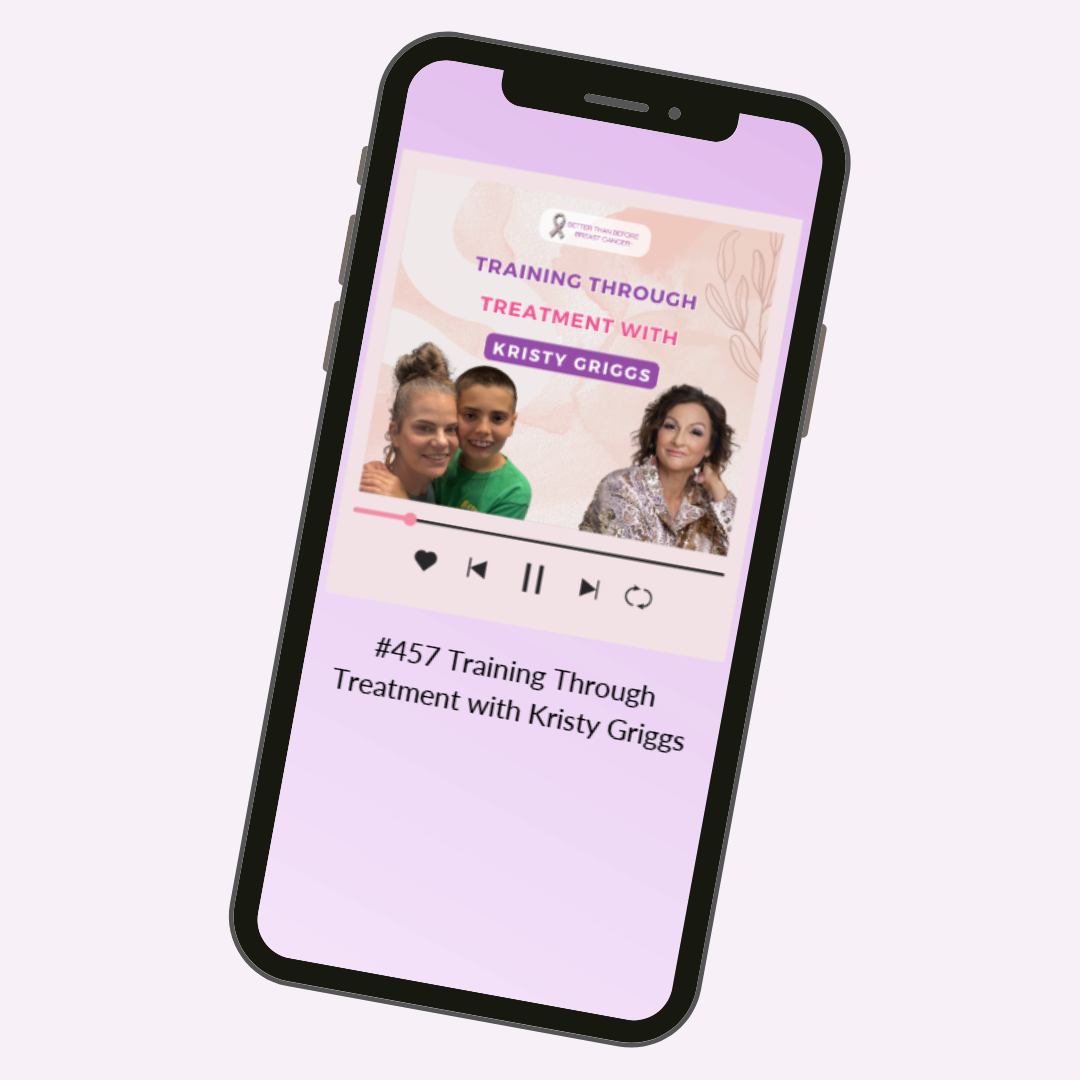




Listen Now! - #457 Training Through Treatment with Kristy Griggs
#457 Training Through Treatment with Kristy Griggs
The Better Than Before Breast Cancer Podcast
with Laura Lummer
There are moments in life when something shifts so deeply that you can’t go back to who you were before.
In this week’s episode of the Nutrition After Breast Cancer series, I sit down with Kristy Griggs, founder of Training Through Treatment, and her story will stay with you.
Kristy was diagnosed with stage four breast cancer at 37 years old as a single mom. She was told to rest. To slow down. To conserve her energy.
But what she found was something very different.
She found that movement was not something that took from her. It gave to her.
She showed up to spin classes during chemotherapy. Sometimes just pedaling in the back of the room. Sometimes leaving early. But she kept showing up.
And over time, that consistency became something more than exercise.
It became identity.
It became strength.
It became a reason to keep going.
There is a moment in this conversation that stopped me in my tracks. Kristy says:
“I don’t do chemo anymore. I do exercise.”
That perspective changes everything.
This episode is not about perfection. It is not about pushing through at all costs.
It is about learning where your line is.
It is about showing up in the way you can.
It is about being in the energy of life, even when things feel heavy.
And maybe most importantly, it is about asking yourself:
What if movement isn’t optional?
What if it is part of how we support our bodies through this?
Listen to this episode and let yourself sit with that question.
Resources Mentioned:
Work with Laura:
https://www.
https://www.
https://www.instagram.com/
💌 Want weekly support, new episodes, and wellness tips in your inbox?
💌 Join my email list for weekly wellness tips & podcast updates → The Breast Cancer Recovery Coach
💌 Join the Better Than Before Breast Cancer Life Coaching Membership → Life Coaching
💌 Join the Living Well After Breast Cancer Community → The Living Well After Breast Cancer Community
👩💻 Follow me on Instagram for daily inspiration → @thebreastcancerrecoverycoach
👩💻 Follow me on Facebook → The Breast Cancer Recovery Coach
🎙 Subscribe & leave a review on Apple Podcasts → Better Than Before Breast Cancer with The Breast Cancer Recovery Coach
🎥 Watch on YouTube → @BetterThanBeforeBreastCancer
About the Host:
Hi, I’m Laura Lummer, The Breast Cancer Recovery Coach.
After two breast cancer diagnoses and years of coaching women through recovery, I’ve learned just how powerful it is to tune into your body and trust its signals. I help breast cancer survivors create healthier, more fulfilling lives through a compassionate, whole-person approach using nutrition, mindset coaching, and lifestyle strategies that support real healing—without guilt or perfection.
Whether you're navigating side effects, struggling with energy, or just want to feel good again in your body, you're in the right place.
Social Media Links:
Facebook | Instagram | Pinterest | YouTube
Thanks for Listening!
I release new episodes every week to support you in your healing journey. If this episode helped you, please share it with someone who needs it, and leave a review to let me know what you loved.
Subscribing to The Podcast
If you would like to get automatic updates of new podcast episodes, simply pop your details in the form below and we'll email you as new episodes release!


Subscribe for weekly episodes
The Breast Cancer Recovery Coach
and get it delivered right into your inbox!
Transcript
0:00
You're listening to better than before breast cancer with the breast cancer recovery coach, I'm your host, Laura Lummer. I'm a certified life coach, and I'm a breast cancer thriver. In this podcast, I will give you the skills and the insights and the tools to move past the emotional and physical trauma of a breast cancer diagnosis if you're looking for a way to create a life that's even better than before breast cancer, you've come to the right place. Let's get started.
0:33
Hey, there, friends. You're listening to Episode 457
0:37
of better than before breast cancer. I'm your host, Laura Lummer, and I am really, really happy to be able to share a very special guest with you on today's episode. So I want to introduce you to Christy Griggs. Christy is the founder and the president of training through treatment, which you're going to hear all about in the show. I was originally introduced to Christy a couple years ago. You'll hear about that too. You hear about our story, about how we came together at a local spin studio, grit cycle, and the amazing work that Christy has done. I not only wanted to share her story here so that you could hear about what she's created in training through treatment, but more importantly, that you could hear the story of the role exercise played in Christie's healing journey. Because I talk about exercise a lot, and if you follow me on social media, I talk about spin and yoga, spin being one of my favorite things, Yoga also and weightlifting. But I really feel like the impact of hearing what exercise has done for someone to understand that it's not just an optional piece. There's a statement that Christy made in her interview, and it just really stuck with me. And she says at one point in her story, I don't do chemo anymore. I do exercise, and that is so powerful. So I wanted you to hear, of course, the story from her own mouth, and I've got to give you a little bit of a caution here. When we were doing the recording, unfortunately, the software was freezing. Didn't appear to be freezing while we were talking, but when this episode went into editing, there was a couple of places where it froze up. So you'll hear tiny little overlap in a couple of places. Know that that was just, unfortunately, where the recording software froze for a second. But it's nothing major. I don't think it's going to really impact your listening, but if you're watching on YouTube, you're going to see quite a lot of freezing in Christie's frame. So just be ready for that. So if that's something that your nervous system can't handle, maybe listen to this one on Audible. So Christy Griggs was 37 years old. She was a single mom with a seven year old son when she was diagnosed with stage four breast cancer. And her story is a really, really powerful and inspiring one, I think it's so important to share these stories, because we all have such different journeys. We may all have a breast cancer diagnosis, but the way we approach them in our lives and the role that they play in our lives is very different for everybody, and so I love sharing a spectrum of different stories, and especially the way that this diagnosis, that this treatment plan, that just the way that a cancer diagnosis impacts someone's life, how it can inspire different beautiful things to grow out of that life, in addition to sharing the tremendous amount of suffering that it can create. So I welcome Christy. I'm so thrilled to be able to have her here as a guest. And hope you enjoy this conversation. Welcome Christy. Thank you for joining me on the better than before breast cancer podcast. I am so excited to have this conversation with you. Thank you
3:55
so much for having me. Laura.
3:56
You are so welcome. It's my pleasure. So you know, Christy, the first time you and I met, I think it's been at least three, maybe four years ago. We met at a grit we all had, like a round table, kind of live stream discussion, and then we went in and did a ride to raise money for breast cancer. And since then, you know, I've followed you. You've done so much, you've been through so much. And every time that I see you, I'm like, Holy hell, this woman is amazing. And so the last time was this last October, I was had the pleasure of doing another ride with you, and I just wanted to have you on the show, because I think you're so inspiring. Your story of what you've been through, how you handled what you've been through, and what you created as a result of it, but also like you. I've said this to you before off camera. I'm like you're a beast like and push yourself to do things you know are good for you. More than almost anybody. I've seen more than. Right? That's for damn so let's start off, and let's just share your story from your perspective. So talk to me about how old you were when you were first diagnosed. When did that happen, and what was the diagnosis, and then what led you to really understanding the value of exercise in your healing program and then creating this amazing organization that you've created.
5:25
So I was originally diagnosed in April of 2021 I was unfortunately misdiagnosed with assist in February of 2020 so when I was diagnosed in April of 2021 I was de novo stage four, so it was in my lymph nodes. It had not hit a bone or an organ, but it was throughout the lymph nodes. So that was April of 2021, so I went through, I did six rounds of tchp, and had a full response to to treatment. So I was able to stay on a HP maintenance program for about 10 months when we saw recurrence. So the plan had been to get to a year, do surgery and, you know, start that whole process. But once we saw recurrence, we decided to start another chemotherapy plan. So at that point, I started N her two and I did
6:29
ask you a question real quick. Let me ask you a question real quick. When you said you had a full response, so you had a tumor in the breast, but after your six rounds of chemotherapy, even that tumor was
6:39
gone, right? So a complete response, so there was no activity in the in the scans. So we knew that there was necrotic or dead tissue. We knew that we wanted to get rid of that, but there was no activity. So the the chemotherapy that I did initially, tchp Six, is all you can do. So either you have a complete response and you go on to, like, a lower maintenance, more of a antibody type medication, and, you know, work your way towards surgery and then radiation, and whatever your, you know, post surgery plan looks like for your team, or you don't have A complete response, you cannot have any more of that chemo combination, but they would then find another treatment that you could continue on to try. The goal always being to get to Ned or no evidence of disease. So once you get to know evidence of disease, that means that you've had a complete response.
7:37
I think something really important about this part of your story is you were told, as many of us are told, we're told, don't take any supplements, don't exercise, right? Just rest and rest, right?
7:51
Is that your story? When I was originally diagnosed, my scans looked awful, right? It had, it had not hit a bone or an organ, like I said, but it had gone to basically all of the lymph nodes in my upper body. So the the first surgeon that I saw was very blunt, told me that there was a chance I had less than six months that, you know, I was not a candidate for surgery, that this was far worse than my doctor had explained to me in the beginning. And basically was like, I can't touch you, I can't open you up. I, you know, you're, you're terminal at this point. You know, we don't use the word terminal anymore, but this is, you know, this is a chronic illness that you're gonna have the rest of your life. I don't know how long I can keep you here. You know, almost, almost, kind of putting me in a box. That box was, it's already stage four, you know, good. Best of luck to you. So I was blown away when I sat with my oncologist the first time and he explained that, like, we need you to rest. We need you to, you know, remember you're sick, remember you're sick and take lots of rest days, because I was, I was an athlete, you know, I couldn't believe I had stage four cancer. I was like, I took two spin classes this morning. What do you mean? I have stage four cancer? You know, I that can't be correct. And then I saw the scans, and I'm like, and I knew, I mean, I felt it at that point. I knew that there was something going on. But it was just so strange to me that things that I loved doing were still so easy to me. You know, I couldn't believe that I was that sick. And so I I kept saying i i can exercise, though I know I can exercise. He told me that was okay to rest, that I needed to rest, listen to my body. And then you kind of get in your head when you're that sick, on chemo, when you go to bed achy because, you know you're holding it down. It's it's hard to push yourself to exercise. And every round of chemo, I got weaker and weaker and weaker until the point that I was down, you know, 20. Five pounds nine weeks in, and, I mean, I was so weak, there was no way I could go to a spin class.
10:07
How do we tell the difference between, wow, today, I can tell my body's not up for something, versus I'm not feeling great, but I know I've got to go do this. Right? That's what can be. I think a lot of people,
10:22
I think it's impossible not to mistake one for the other. I mean, you you feel like crap all day. So how do you know if you just feel like crap, or if your body is telling you not today, like I can't do it today. I I would still show up like, I've got pictures of myself and on the bike ball does a cue ball. And I would just be on a bike in the back, and I would just tell myself like, no judgment if you can't do anything but pedal like nobody. People are proud of you for being here. I'm proud of you for being here, just see what you can do. And to me, what that would do is it took out the ego first of all, right, I don't know. Nobody is caring. I'm not in the front row. Nobody's trying to watch me. To keep up, I can just do whatever I need to do. I'm only going to do what I can do, but I'm going to do as much as I can do. And that mentality then basically gives you not an out, but it gives you like, like you're it validates you, right? You're here, you've shown up. That's the hardest part of you, of what you're going to do today, is showing up, because now, now you're you felt like crap. You might be too sick for this. There's only one way to know. You know, there were classes that I had to get out and leave. There was one class in particular that I kept thinking, like, I can do it. I knew about the halfway part of the class. I'm like, I can, I can do it. I know I can do it. And then I couldn't, I could not do it anymore. And so I unclipped, and I was just going to get my car and leave, you know, at first I laid on the floor, on the cold floor for a while and let my heart rate come down. And then I was going to leave. And I thought, no, the worst thing I can do is just leave, because everybody's worried about me right now. You know, the poor instructors having a heart attack. I waited i Everybody saw me. I'm all right now I know like I will remember the feeling that I had this morning. I will remember that that is the line for me. You know, it takes work to find out, am I just sick, or am I just feeling sick today, or am I sick today? Like finding that line takes work. It's not an easy thing to do. You have to push yourself to that failure point like that. Okay? That feeling, that feeling that I had when I put my feet on the ground this morning, that's the line for me. I That's a day I need to rest. I love
13:11
that, and I love that giving yourself grace. And I love that you're bringing up. It's like, Hey, I didn't get up right, right, right there, and badass on the podium in a spin class. And for people listening who've never been to a spin class, or those of us in the amphitheater, then there's those of us up on the podium, but yeah, you know, and I can totally identify with that. Like there are times when I what I have had to say to myself, just go. Just go and write and sit there and give yourself grace. And I think it's not only that I got up and did something for myself, even if I sat there the whole time, even if I just barely get my legs the whole time, but I was also in the energy of wellness. I was in the energy of music and people having fun and giving myself the the thought and the energy that I'm here, right? I'm showing up and I'm well too.
14:06
It is so motivational to everybody around you to see someone that you know is sick and they are there anyway. You know, there have been people in that class that use a walker to get to their bike, and then they ride the class like there's not a thing in the world that's going to inspire me more than that today. You know, seeing somebody show up anyway is a very motivate, motivating thing. And so it was absolutely the energy, and that's why I would tell myself, you know, just clip in, just move your legs and soak in like, be selfish today, walk in and tell I would tell people like, I'm going to be an energy vampire. Today, I'm going to take all of the good stuff that you guys are willing to pump out. I need it desperately today. Day, and there were days that that's what I did. I wasn't on beat, I wasn't giving out the, you know, the motivation. I was taking the motivation. And that's okay too, because there are days now that I show up and I feel so great that I'm giving everybody that energy, right? Because there's somebody in that room that needs it, but such a huge part of survivorship is, did you have a community? Did you have people that were that showed up when things got real? I mean, there was a line out my door of people that were showing up for me. You know, friends became family. I everybody had a key to my house, you know. I mean, I had so many people because, again, I'm a single mom, you know, my I have, my son is autistic, and He is the light of my life, but it was hard to parent him while I was also fighting for my life, you know, so I mean people, everybody lifted me up. I was so loved on the whole time. And you can see, I mean, there are articles now on the the increased risk of overall survival if you had a tribe. And so I tell people all the time, like, find your people.
16:26
Yeah, I love that. I want you to send that message, because I know so when I was first diagnosed, my well, both my first diagnosis, I was also a single mom. Two of my four kids still lived at home with me. And you know, I hear from a lot of single moms, and I hear from a lot of women like, I gotta do this on my own right? There's such a resistance, and we have such this wild mentality. I don't know why, if it's a western society thing, but that you can ask for help, and you don't want to be a burden, and you don't want to look like a victim. And one of the things that stood out to me after my first diagnosis, and definitely my second was my experience with my brother, he had testicular cancer when in 1993 unfortunately, he did lose his life to that cancer. But loving someone with cancer taught me that the only thing you can do as a support person is ask them, What can I do? How can I show up? Can I cook for you? Can I clean for you? Can you sit with you? Can I watch a movie with you? We want so desperately to fix them and heal them, which we have no power to do, right? So it's really an act of love to allow your community to show up for you, right to and I think it's an act of it's a personal development to allow yourself to receive it's so healing. And I know you had a really difficult time in that six rounds of chemotherapy, and you shared something with me that I think is really powerful, because it's a great example of how you prioritize yourself in the moment when you needed it, so that you could achieve the goal of healing and be there for the person you love the most in the world, your son. And what was that?
18:09
Yes, my mom and dad are in South Carolina, my sister's in North Carolina, and I knew that I couldn't fight the way that I needed to fight and also be the mom that he needed. My son was seven at the time, and is autistic and just he needs. He needs so much love. He is, He is love. He is such a ball of energy that he has to, you have to be 100% present with him. And there was no way that I could choose that or chemo. It was an impossible choice. And so I did the hardest thing I've ever done in my life. I put him on a plane. My mom was out here, so she flew with him to the Carolinas, and he spent six weeks, you know, the rest of summer, with my family, so that I could then try to just put my nose down and get through the rest of of the treatment plan. I was able to be as sick as I needed to be, and so I printed dozens of pictures of my son, and I taped them on the floor. I taped them all over my mirror. They were on my refrigerator, so that I couldn't look anywhere in my house without looking at him to remind myself, this is why you're this sick. Yes, you are sick. You're really, really sick, and this sucks, but you're doing it for him. So I was allowed to then not have to close the door when I'm running to go, you know, lose my lunch because I don't have to worry about what I'm hiding from him, but I was constantly bombarded with his angel face. You know, I love it. Thank you.
19:52
That is such a great story. That's a really, really powerful story, and thank you for sharing that with us. So let's go. So. Now you've been through this,
20:03
and then, I know, 10 months, and I had a recurrence. So when that happened, I was so mad. I was so angry, because I had done everything the doctors had told me. They told me to rest, and so, you know, to listen to my body, and they told me to, you know, not to take supplements and not to do all the things that I had done before, to let the medicine do its job. And it came back. And so I, I sat with my oncologist, and I told him, like I did it your way the first time. I said, I will still do all of the chemo. I'll do whatever the medicine is that you want me to do, but I'm going to do this my way. This time I said I'm going back to exercising every day, and if that means I have to come here every day and I need you to give me an IV of fluids, then that's what I'm going to do. And that is what I did. That's what I had to do. And but I explained to him, I said, this means I can do something that I know is going to save me as much as the medicine. And at first he fought me. He didn't fight me on on hydration. He was perfectly fine with it, but he fought me on the idea that exercising was worse than being tired all day. And I told him, I said, I know it is, I know it is like I'm I am very, very fortunate. I know that not everybody has found a type of exercise that they love. I am. Am blessed in that I love exercise in general. I love the spin classes I take. I love going to the gym and lifting heavy weights. I love exercise. I'm very, very fortunate. So I I knew it's what my body at least wanted. I knew that I feel better mind, body and soul after a very hard workout. So that tells me it's what at least my body needs, you know, and if I find something that just gives me a light because when I stepped into that second treatment plan, the treatment plan was forever, right? I was going to be on end her too, until it either stopped working or I saw progression, and I, you know, we went on something else. And so what I explained to him is I said, when I was on a treatment plan prior, I had an end date, I had an 18 week end date, I could put my head down and just get there, but now there's no light at the end of that tunnel. I'm just going to be getting sick every, you know, three week cycle for the rest of forever. And so you have to give me things to look forward to, and for me, that community, those the people that love me so hard in that room, and the way the the strength that I feel when I'm able to pick up something really heavy at the gym, you know, I need that. I need those endorphins. And he said, All right, you know, you do. You do what you think is going to work. And so I had four cycles of Ben her two, and had a PET scan at that point, and we knew I had a complete response, so we knew that it was working, and then we can we continue? About a year in, I started having really, really bad side effects, and so we kind of started playing around with, you know, stretching out the time between doses a little bit. We lowered the dose a couple of times. We took breaks. And finally, I was getting sicker and sicker every round. And so I started having lung issues. So I saw a pulmonologist who said, at this point, no, we're stopping now we have to give your lungs a break. He commended me on still spinning, because I was still going to spin every single day, even on the really bad days again, I wasn't necessarily on podium. There's plenty of times I was in the back, but I would show up every day. And so the doctor explained. He said, your lungs only, did you know, I did 25 rounds of end her too, because they were so strong from, from Spin, you know, from from so much exercise. And so we stopped. At that point, we stopped. And that was January of 2024, so we stopped treatment with, you know, the expectation that it was going to come back, and when it did, we would, you know, adjust and start something new, and lo and behold, it just hasn't come back. So I am two years, two years in remission at this point.
24:54
Fantastic. Congratulations. That's amazing.
24:58
I'll never forget. I don't. First time he looked at me and he did not see my diagnosis. I could tell, I could tell that although, and I don't mean that I was ever just a diagnosis to him, but he looked at me as somebody that was just going to live like He really, truly saw that I was going to make it, and that was about a year ago, and he told me, he said, you know. He said, don't get me wrong, I saved your life with chemo. He said, You know, you you are here in and I agreed. I agreed, like, yes, Western medicine for the win. But he said, but you are only alive now because of your lifestyle. He said, You You made the decision that you were going to live because I told him, I said, on our first meeting, I said, I cannot imagine how difficult it must be to look a young single mom in the eyes and say, you know, I don't know that I can save you. I'm going to try really, really hard, but I don't, I don't know that I can save you. I said that that must be, that's an impossible task. I said, but I guarantee you that you have never had a patient that has to live as desperately as I have to live. My son needs me in a way that not every child needs their mom and not not that any moms are more or less or less important, but my son needs me in a way that nobody else will be me. Nobody else has sat through the IEPs and the doctor's appointments and the therapy sessions, and nobody else advocates the way that I advocate. I am not allowed to die at 37 years old. I'm not going to die like I need you to understand that I will do whatever it takes to live. And so he said, If you will do anything it takes, then you will never have another sip of alcohol the rest of your life. And I said, done. Like, give me something harder. What else? What else? And so I mean, that was my that was my mindset going forward. I said, I am I will do whatever it takes, and that that mindset makes it impossible to not also show up at spin when I'm sick. It's a hell of a mindset.
27:39
So tell me how you've started this amazing organization that we're going to talk about training through treatment. When did you get that idea what so, I think so many times as women go through, obviously, a life changing, life threatening, I mean such a profound experience as a diagnosis and the treatment of breast cancer or any kind of cancer, and a light to fire in us like it did with me, right? It's like, this is the community I'm going to serve. This is
28:04
what I'm going to do. I was not working,
28:08
you know, keeping a roof over mine and my son's head had to be my only focus. And so, you know, exercise classes are very much a luxury, right? And so, luckily, the generosity of the incredible people at grit i, i When, when the cancer came back, I called up Lisa from from grit cycle, who was no one of my, one of my dear friends, and I, I told her, you know, it's back, and I have to get back to exercise, and I don't have any money, and I don't know what to do, but I have to be there. And she said, show up. She said, I will take care of everything else. Just show up. And so I showed up every day, and there was a guest bike for me every single day, no matter whose class I was taking, no matter what time I was taking, it I was able to ride and and I, I told her, and I sat her, her and Gail down, and I told her that. I told him I had an idea that I wanted to, I wanted to pay it forward. Somehow I knew that they didn't need me to pay back the classes that they had given me, but I need, I needed to pay it forward, because this was something like I just I knew it was part of why I was still alive. I knew it was why treatment was working. I knew it was why I was able to handle treatment. And so I told them, You know, I don't know what I'm doing, but I'm looking at starting a nonprofit, and I want to just gift people classes, and, you know, whether they want to go to spin, or they want to go to boxing, or they want to go, you know, to somewhere else, like, I want to just give, give them classes. And so it was just a very flicker of an idea, and they both said, if you, if you build it, we'll help you. You know, we, you have our support. And so I started the process of starting a, you know, nonprofit. And lo and behold, I I had the right people in my life. I had a friend that whose sister in law was an attorney, and she was able to help set me up with, you know, the paperwork that I needed for the 501, c3, and and, you know, I just everybody kind of fell into place, and before I knew it, you know, a couple years later, we had it. It was here, amazing. So as it stands now, what we do is we just give her the money that she needs for her class pass so she gets her full class pass credits are taken care of. We have a client or a member that she just let, she just goes to spin, she goes to grit and so we buy all of her grit classes every month. You know, she, she, I, she just does. She logs into her app, and she just sees that the classes are there. So we just, we give her the credits, and she's able to book whatever she wants. We do have, we've had people on the East Coast that are too sick to go to classes, you know, they don't have the immune system to be able to be in a room of 50 other people that are sweaty. And so what we did is we actually bought them bikes to have at their home, and then they can do an online type course and have it, you know, in their garage or in their living room, wherever they have their bikes. So we are looking at expanding and doing, you know, again, if people utilize class pass that's something that's easy for us to do. We just buy the class pass credits. Otherwise locally, if they have a local gym that they that they go to, we unfortunately are still too small of a nonprofit to be able to gift them to everybody with cancer, unfortunately, but for metastatic cancers, we our thing is vigorous exercise, because that's where most of the data is. In fact, new, recent data that's come out suggests that for cancer, purposes of to avoid death from cancer. One minute of vigorous exercise is equal to four minutes of moderate or an hour and a half of light. So vigorous exercise is where the data is. So that's what we gift for man.
32:19
That is amazing. So it's so powerful. Somebody's out there hearing that message as you resist exercise, I don't know what else can help you get up and go exercise. If that isn't something that motivates
32:32
you, the data suggests that you need to exercise. Like I tell myself that I don't take chemo anymore. I take exercise. It happens every day, whether I want it to or not, you have to do it just like you would have to take chemo. And so it's not a grant, it's not a one time thing, it's three classes a week, or the cost of, you know, a bike, if somebody would rather do it at home. I really believe that no one of the most common questions I always get is, what is the best exercise? And my response is always, whatever vigorous exercise you will do on a consistent basis, if you are someone that like financially, you're not going to be able to do anything extra, find a local park and do sprints. Doing 20 minutes of sprint work is going to give you exactly the same benefits we see that we want you to you get get your heart rate elevated, right? We want you to not be able to have a conversation. Spark. Sprinting is excellent, excellent, vigorous physical activity, and it doesn't cost anything. I love spin. A lot of my friends like you love spin. We have people that that is that has become what they love. One of my girlfriends that is one of our members. When she first came to us, she had a different gym that she went to, and so we paid her membership at a different type of gym. And I, you know, it took a few months to convince her, I was like, please come as my guest. Please come ride sometime. And so she came and she took a spin class, and she loved it. And so she came and she took another spin class, and within three months, she had said, Can Can I switch my membership, and can I just go to grit? You know, she had found her people. She had found something that she loved, and is a long as it's vigorous, so we don't do a lot of yoga, just because it really again. We want to see a little bit higher of heart rate for most of the data that we have seen. But we are very open to whatever, whatever works. You know, not everybody loves spin, not everyone loves running, but I promise you can find something I rode like 1000 classes. Says as a guess, while I was sick, and you know, the generosity of grit is incredible. They really, they really, really, are part of why I'm still here. And then the people are it's just it's so much more than a spin class than an exercise class, and that's why I tell people like and part of the reason I like to say that is because, if you're in a fitness class somewhere and you don't feel that, okay, find, find something else you're not with your people, you know, because it should, you should be excited to see these people. You should be excited to suffer with them, you know, to do the hard things with them, something that I've always said, if you look at all of my friends, all of my friends are people that I met at spin or at the gym, or I trained them, or they trained me somewhere in fitness, they fell into my life. And I remember thinking like, Why? Why is it that all of my friends, like, literally all of my friends, are people that I work out with, and it hit me, I said, you know, I when you do something really, really hard, physically, it makes you vulnerable. And the relationships that you forge during times of vulnerability like that. Those are really powerful friendships. Those are really powerful relationships. And I mean, those are the people that showed up, friends from Spin. Are the people that took me to and from chemo because I couldn't drive. You know, they showed up to help me with you know, they did medical billing for work. So they showed up to help me figure out my insurance, you know, or you know, they dinner. Showed up on my porch. You know, an acai bowl gift certificate is on my phone. I mean, they found ways to support me during the literal fight of my life, and these were people that would not have been in my life if I wasn't taking a spin class. You know, it's wild. It's hard to describe how it fills the soul, quite literally, to be bombarded with people telling you You are amazing. You are amazing. Look at you go, you can do like you're just being bombarded with it because you chose to show up and they see the struggle. They're allowed to see the struggle. I didn't want to wear a wig. A, it was uncomfortable, but b I don't want to rob people of the motivation that I'm going to give them. That's not to rub noses in it. That's not to say, Hey, look at me. That's because it's going to be motivating as hell for people to see me and I was green. Don't get me wrong, there are Jace, one of my dear friends, Craig, that's been riding with us for years. He'd yell at me. He'd say, you're green again, Griggs, when he'd see me walk up because I was just nauseous from my toes to my ponytail, you know. But I would show up and I would ride the way I could ride. However, whatever my everything was that day, I think a misconception that we have is I only have 80, so I'm only going to give 80 today. No focus on I only have 80. So I'm going to give 100%
38:33
of that 80. It's only 80, but I'm going to give all of it, because if I'm only giving 80 of my 80 that I'm barely given anything, you know, but showing up and having those people high five you when you clip in, there's, there's no feeling like that. There really isn't, you know, the people in it can be very, very intimidating to walk into a big box gym, to walk into a big gym where you don't know anybody. But the beautiful thing about small boutique, you know, fitness classes, whether it's spin or hot yoga or whatever it might be, is you tend to see the same people in the same class. You know, the same Wednesday, you know, Monday, Wednesday, Friday, or Tuesday, Thursday, whatever it may be, you get to see the same faces if you go at the same time, and then people get to know your name. And there is nothing like being in that class and the lights are dark and the music's loud and people are screaming names, you know, hey April, Hey Nikki, Hey Dan, you know, it's, there's nothing like that feeling. It's it everybody feeds off of that. You know, everybody's day is better because they left a spin class where somebody that they didn't know six months ago celebrated a sprint that they did. You know that the day is better now it. Is it is magic in a bottle. It really
40:03
is well. Thank you so much for your time. Thank you for sharing your story. Thank you for building such an amazing organization. And it is been an absolute pleasure to have you here. All right, friends, I hope you really enjoyed that I am going to put all of Christy's contact information in the show notes for this episode, which you'll find at the breast cancer recovery coach.com, forward slash, 457, or you can just look right here where you're watching this on YouTube or listening to it on your favorite podcast platform, and click on the links below to check out the training through treatment website. Or follow Christy on social media, which I hope you do, because she's really an amazing inspiration. All right, thank you for listening. Get out there and get your body moving. Be good to yourself. Expect others to be good to you, and I'll talk to you again next week. Take care.
40:53
You've put your courage to the test, laid all your doubts to rest. Your mind is clearer than before, your heart is full and wanting more. Your Future's at the door.
41:12
Give it all you got no hesitating.
41:15
You've been waiting all your life.
